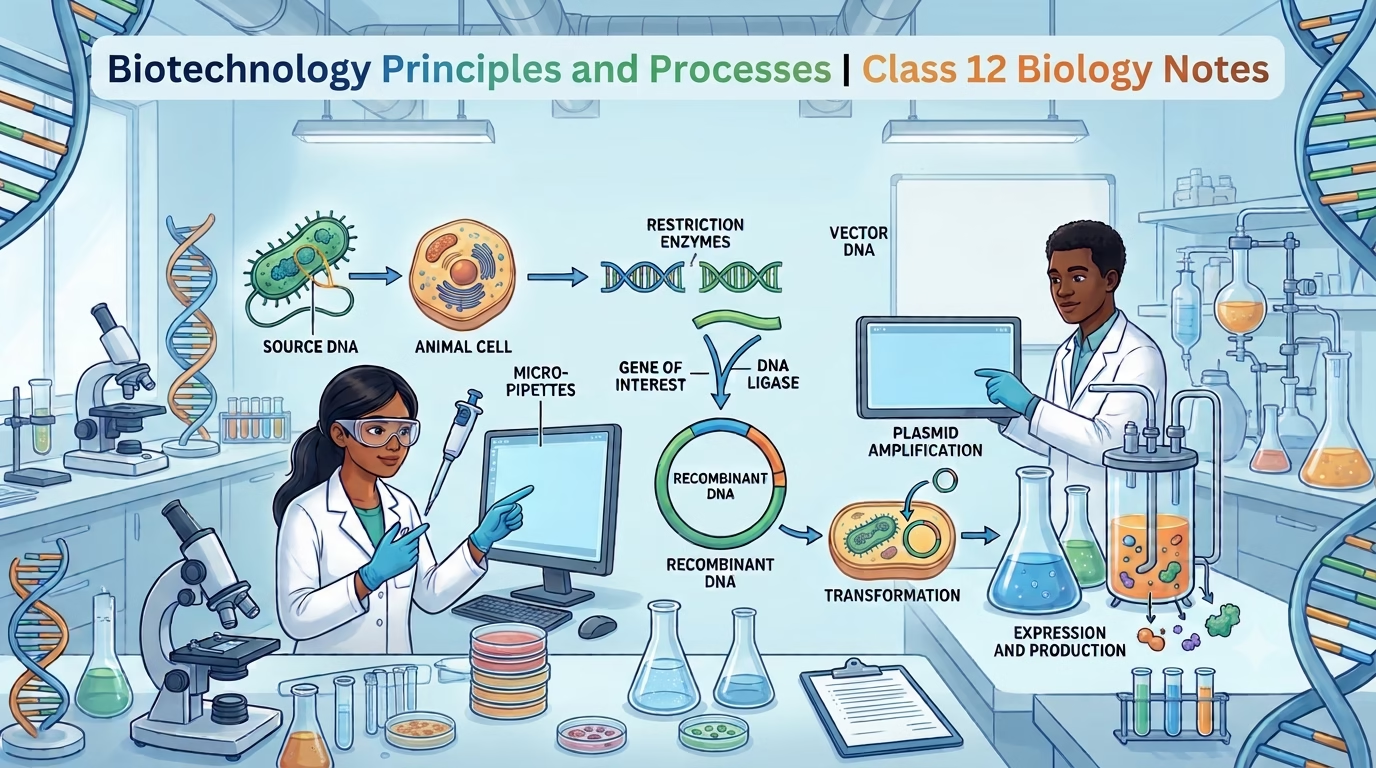
NCERT Class 12 Biology, Biotechnology: Principles and Processes: Class 12 Biology Notes, Chapter 11 in older editions and Chapter 9 in the rationalised edition. Useful for CBSE boards, NEET and CUET.
Quick Summary
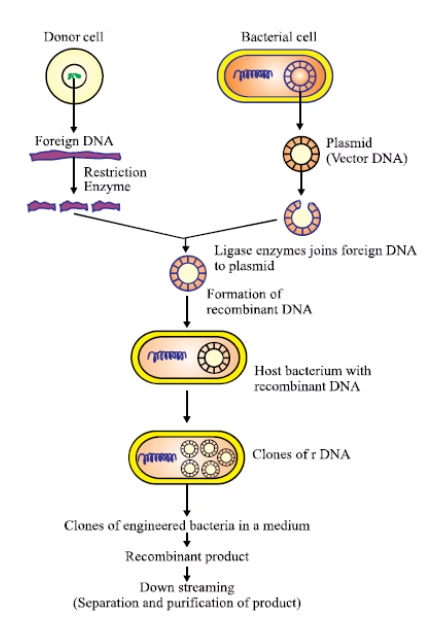
Biotechnology uses living organisms, cells or their molecules to make products and services. Modern biotechnology rests on two core techniques: genetic engineering (altering the genetic material of an organism) and bioprocess engineering (keeping conditions sterile so that only the desired microbe or cell grows and makes a product). In recombinant DNA technology (rDNA technology), a gene of interest is cut out with restriction enzymes, joined to a vector with DNA ligase, placed in a host, multiplied, and finally expressed in a bioreactor. The crude product is then purified by downstream processing.
1. What is Biotechnology?
Biotechnology is the use of biological systems (whole organisms, cells or parts of cells, and molecules) to create useful products and services. It has applications in agriculture, food processing, medicine and diagnostics, bioremediation, waste treatment and energy production.
The European Federation of Biotechnology (EFB) defines it as the integration of natural science and organisms, cells, parts thereof and molecular analogues for products and services.
Extra information: Traditional biotechnology includes making curd, bread and wine with microbes. Modern biotechnology goes further by deliberately changing genes, which is why it can produce human insulin in bacteria or pest-resistant crops.
2. Principles of Biotechnology
Two techniques form the basis of modern biotechnology:
- Genetic engineering: Techniques that alter the chemistry of genetic material (DNA or RNA), introduce it into a host organism and change the host’s phenotype.
- Bioprocess engineering (aseptic processing): Maintaining a contamination-free environment in chemical engineering processes, so that only the desired microbe or eukaryotic cell grows in large quantities for products such as antibiotics, vaccines and enzymes.
3. Genetic Engineering and Cloning
Why do we need genetic engineering?
Asexual reproduction preserves genetic information, while sexual reproduction generates variation. Conventional plant and animal breeding (hybridisation) often brings undesirable genes along with desirable ones and cannot cross species barriers. Genetic engineering overcomes this by moving only the wanted gene.
Three basic steps of genetic modification
- Identification of DNA with the desirable gene.
- Introduction of that DNA into the host.
- Maintenance of the introduced DNA in the host and its transfer to the progeny.
Why does foreign DNA need a vector?
A piece of foreign DNA cannot multiply on its own in the host unless it is part of a sequence that has an origin of replication (ori). When the foreign DNA is joined to such a sequence, it is copied along with it and many identical copies form. The process of making multiple identical copies of a DNA segment is called cloning.
The first recombinant DNA
In 1972, Stanley Cohen and Herbert Boyer made the first recombinant DNA. They joined an antibiotic resistance gene to a native plasmid of Salmonella typhimurium and used it to transform E. coli. They used restriction enzymes to cut the DNA and DNA ligase to join it.
Construction of recombinant DNA: overview
- Isolate the plasmid (a circular, autonomously replicating, extra-chromosomal DNA) to act as a vector. Many plasmids also carry antibiotic resistance genes.
- Cut the plasmid and the DNA of interest with the same restriction enzyme.
- Join the two with DNA ligase to form recombinant DNA.
- Introduce it into a host such as E. coli, where it replicates using the host machinery.
- Grow the host on antibiotic-containing medium. Only cells carrying the resistance gene survive, and this helps isolate the recombinants.
4. Tools of Recombinant DNA Technology
| Five tools of rDNA technology and their functions | |
| Tool | Function |
| Restriction enzymes | Cut DNA at specific recognition sequences (molecular scissors) |
| Polymerase enzymes | Synthesise DNA (for example Taq polymerase in PCR) |
| DNA ligases | Join DNA fragments (molecular glue) |
| Vectors | Carry and replicate the gene of interest (plasmids, bacteriophages, Ti plasmid, disarmed retroviruses) |
| Competent host | Takes up the recombinant DNA and multiplies it (for example E. coli) |
5. Restriction Enzymes
Restriction enzymes are specialised nucleases that recognise and cut DNA at specific base sequences. Werner Arber first proposed their existence. Hind II, the first restriction endonuclease to be isolated, was found to cut DNA at a specific point by recognising a particular six-base-pair sequence. Over 900 restriction enzymes have since been isolated, each recognising a different sequence.
Types of nucleases
- Exonucleases: remove nucleotides from the ends of DNA.
- Endonucleases: cut DNA at specific positions within the DNA. Restriction endonucleases belong here.
Palindromic recognition sequences
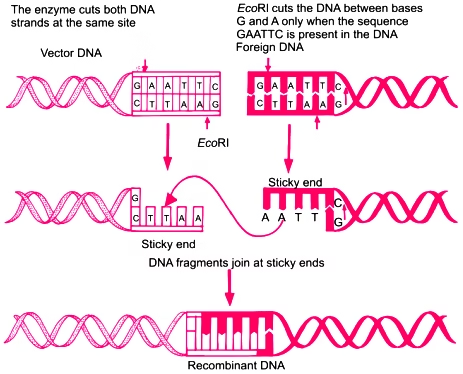
A palindrome in DNA is a base-pair sequence that reads the same on both strands when read in the same direction (5′→3′). Example for EcoRI:
5′ – G A A T T C – 3′
3′ – C T T A A G – 5′
How EcoRI cuts DNA
The enzyme cuts each strand between the same two bases (G and A) but a little away from the centre of the palindrome. Because the cuts on the two strands are staggered, short single-stranded overhangs called sticky ends are produced.
Before cutting : 5′ – G ↓ A A T T C – 3′
3′ – C T T A A ↑ G – 5′
After cutting : 5′ – G A A T T C – 3′
3′ – C T T A A G – 5′
Sticky ends are so called because they base-pair (through hydrogen bonds) with complementary sticky ends, and the gap in the sugar-phosphate backbone is sealed by DNA ligase, which forms phosphodiester bonds. Since the vector and the foreign DNA are cut with the same enzyme, their ends match.
Common mistake: Hydrogen bonds between sticky ends are formed by base pairing. DNA ligase does not form them. Ligase seals the sugar-phosphate backbone.
Extra information: Some enzymes (for example SmaI) cut both strands at the same point and give blunt ends without overhangs. Blunt ends can be ligated too, but less efficiently than sticky ends.
Naming of restriction enzymes
| Part of the name | Meaning | Example: EcoRI |
| 1st letter | Genus of the source organism | E = Escherichia |
| 2nd and 3rd letters | Species of the organism | co = coli |
| 4th letter | Strain | R = strain RY13 |
| Roman numeral | Order of isolation from that strain | I = first enzyme isolated |
6. Gel Electrophoresis
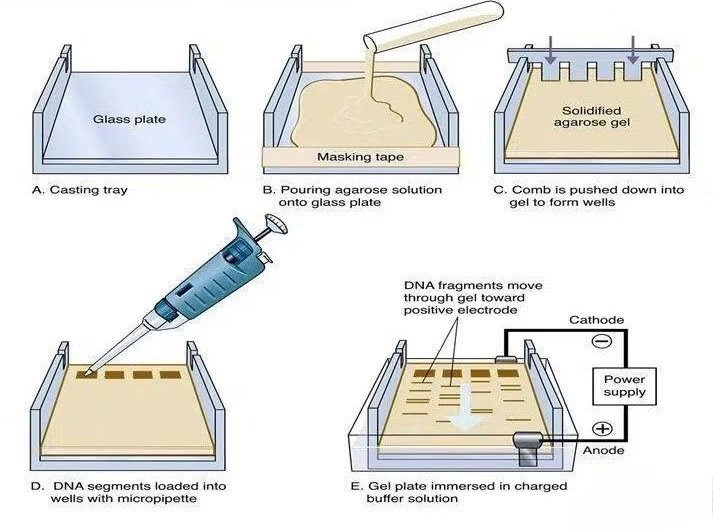
Gel electrophoresis separates the DNA fragments produced by restriction digestion.
- DNA is negatively charged because of its phosphate groups, so in an electric field the fragments move towards the anode (positive electrode) through the agarose gel.
- The gel acts as a sieve. Fragments separate by size: the smaller the fragment, the farther it travels.
- The gel is stained with ethidium bromide and exposed to UV light. DNA appears as bright orange bands. Without staining, DNA cannot be seen.
- The required band is cut out of the gel and the DNA is extracted from it. This step is called elution.
- The purified fragments are used to construct recombinant DNA.
Safety note: Ethidium bromide is a mutagen, so it is handled with gloves. UV light can damage eyes and skin.
7. Cloning Vectors
A vector is a DNA molecule that carries foreign DNA into a host and multiplies it there. Plasmids and bacteriophages are the commonly used cloning vectors because both can replicate independently of the host chromosome.
- Bacteriophages: have a high copy number of their genome inside the bacterial cell.
- Plasmids: copy number ranges from 1–2 to 15–100 per cell.
- The foreign DNA is multiplied to the same number as the copy number of the vector.
Features required in a cloning vector
| Feature | Role |
| Origin of replication (ori) | Starts replication. Any DNA linked to ori can replicate. It also controls the copy number, so a suitable ori is chosen to obtain high numbers of the recombinant DNA. |
| Selectable marker | Identifies and eliminates non-transformants and lets transformants grow. Examples: ampR (ampicillin), tetR (tetracycline), chloramphenicol and kanamycin resistance genes. |
| Cloning sites | Recognition sites for restriction enzymes (EcoRI, HindIII, BamHI, PvuI and others) where foreign DNA is inserted. The vector should have only one (or very few) recognition site for the enzyme used. More than one site would cut the vector into several pieces and complicate cloning. |
pBR322: a model plasmid vector
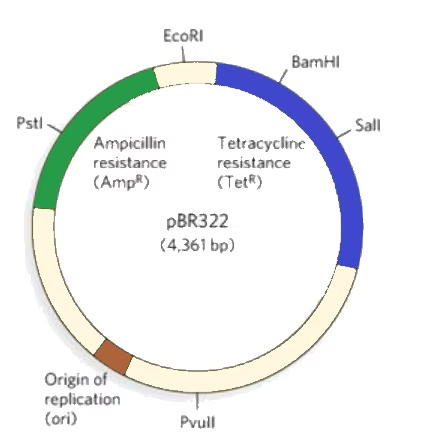
The name pBR322 stands for p = plasmid, B and R = Bolivar and Rodriguez (the scientists who developed it), and 322 = the number allotted to it. It has ori, the genes ampR and tetR, and rop (which codes for proteins involved in plasmid replication). Restriction sites such as PstI and PvuI lie inside ampR, while BamHI and SalI lie inside tetR.
Vectors for plants and animals
- Ti plasmid of Agrobacterium tumefaciens: This soil bacterium infects plants and causes tumours (crown gall). It naturally transfers part of its Ti plasmid (T-DNA) into plant cells. Scientists remove the tumour-causing genes (disarming) and use the modified plasmid to deliver desired genes to plants.
- Retroviruses: Animal viruses that can cause cancer. Disarmed retroviruses are used to deliver genes into animal cells.
8. Selecting Recombinants: Insertional Inactivation
After transformation, only some cells carry recombinant plasmids. Others carry the original plasmid (non-recombinants) and many take up nothing. A selectable marker is used to sort them out.
(a) Using antibiotic resistance genes
- Suppose tetR has a BamHI site and the vector is cut with BamHI. The foreign DNA is inserted inside tetR, so this gene is inactivated in recombinants (insertional inactivation).
- Transformed cells are first plated on ampicillin. Both recombinants and non-recombinants grow, because ampR is intact. Untransformed cells die.
- Colonies are then transferred to tetracycline medium. Recombinants fail to grow, while non-recombinants grow.
- The colonies missing on the tetracycline plate are the recombinants, and they are picked from the ampicillin plate.
Limitation: This method needs plating on two different media and is time-consuming.
(b) Using β-galactosidase (blue-white screening)
- The vector carries the gene for β-galactosidase. The foreign DNA is inserted within this gene, which inactivates the enzyme.
- Cells are grown on a chromogenic substrate (such as X-gal).
- Non-recombinants: active enzyme breaks the substrate, giving blue colonies.
- Recombinants: inactive enzyme, so the colonies are colourless (white).
This method needs only one plate and gives a clear visual result, so it is preferred.
| Method | Marker used | Recombinant shows | Non-recombinant shows |
| Antibiotic selection | tetR (with BamHI insertion) | Grows on ampicillin, dies on tetracycline | Grows on both |
| Blue-white screening | β-galactosidase | Colourless colonies | Blue colonies |
9. Competent Host and Transfer of Recombinant DNA
DNA is hydrophilic and cannot pass through the cell membrane easily. The host must therefore be made competent, meaning able to take up DNA.
| Host | Method | How it works |
| Bacteria | Calcium chloride + heat shock (transformation) | Cells are treated with divalent cations (for example Ca2+), incubated with recombinant DNA on ice, given a heat shock at 42 °C for a short time, then returned to ice. This increases DNA uptake. |
| Animal cells | Microinjection | Recombinant DNA is injected directly into the nucleus of the cell. |
| Plant cells | Biolistics (gene gun) | Cells are bombarded with high-velocity microparticles of gold or tungsten coated with DNA. |
| Plant / animal cells | Disarmed pathogen vectors | A. tumefaciens (Ti plasmid) for plants, retroviruses for animals. |
10. Processes of Recombinant DNA Technology
rDNA technology follows these major steps in order:
- Isolation of the genetic material (DNA)
- Cutting the DNA at specific locations with restriction enzymes
- Isolating the desired fragment by gel electrophoresis
- Joining it to the vector with DNA ligase
- Amplifying the gene of interest using PCR
- Inserting the recombinant DNA into a competent host
- Obtaining the foreign gene product
- Downstream processing
Step 1: Isolation of DNA
- DNA must be obtained in pure form, free of other macromolecules.
- Cells are broken open with enzymes: lysozyme for bacteria, cellulase for plant cells and chitinase for fungi.
- RNA is removed with ribonuclease, and proteins are removed with protease. Other contaminants are removed by suitable treatments.
- Adding chilled ethanol precipitates the purified DNA, which appears as fine white threads. These are spooled out.
Step 2: Cutting DNA at specific locations
- Purified DNA (source DNA and vector) is incubated with the chosen restriction enzyme under optimum conditions.
- The digestion is checked and the fragments are separated by agarose gel electrophoresis.
- The vector is cut with the same enzyme, and the gene of interest is joined to it with DNA ligase to give recombinant DNA.
11. Polymerase Chain Reaction (PCR)
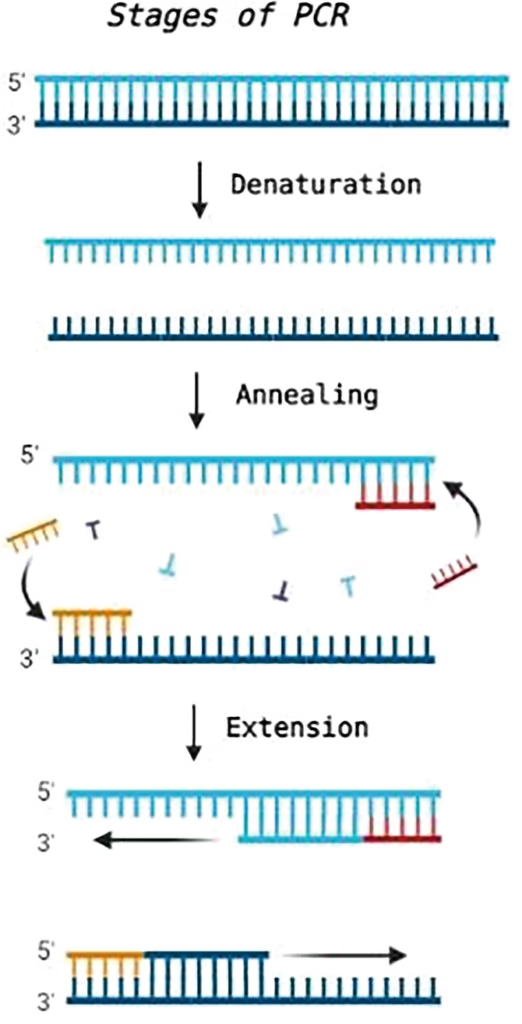
PCR (developed by Kary Mullis) makes many copies of a DNA segment in vitro using primers and a thermostable DNA polymerase. The amplified fragment can then be ligated with a vector.
Requirements
- The template DNA containing the target region
- Two primers (forward and reverse): short, chemically synthesised oligonucleotides complementary to the ends of the target region
- Thermostable DNA polymerase (Taq polymerase) isolated from Thermus aquaticus
- Deoxynucleotides (dNTPs) and suitable buffer
Three steps in each cycle
| Step | Typical temperature | What happens |
| 1. Denaturation | about 94 °C | Heat separates the double-stranded DNA into two single strands. |
| 2. Annealing | about 50–60 °C | The primers bind to their complementary sequences on the single strands. |
| 3. Extension | about 72 °C | Taq polymerase adds nucleotides to the 3′ end of each primer, copying the template. |
The cycle is repeated about 30 times. Since the number of copies doubles each cycle, after n cycles there are about 2n copies. Thirty cycles give roughly 1 billion (109) copies.
Why Taq polymerase? It is thermostable, so it is not denatured during the high-temperature step and does not need to be added again in every cycle.
Applications (extra): Detecting HIV in suspected AIDS patients at an early stage, detecting mutations in genes of suspected cancer patients, forensic DNA fingerprinting, and amplifying genes for cloning.
Insertion of recombinant DNA into competent cells
The recombinant DNA is introduced into the host by transformation (bacteria), or by disarmed vectors, biolistics or microinjection (plants and animals). Cells that took up the recombinant DNA are identified by the selectable marker.
Obtaining the foreign gene product
- The gene is expressed in the host to give a recombinant protein. A protein made from a gene expressed in a heterologous (foreign) host is called a recombinant protein.
- Small-scale cultures are grown in laboratory flasks, but for large-scale production, optimum conditions are provided in a bioreactor.
- Continuous culture: used medium is drained from one side while fresh medium is added from the other. Cells remain in the log (exponential) phase, producing a larger biomass and higher yield of the desired protein.
12. Bioreactors and Downstream Processing
Bioreactor
A bioreactor is a vessel in which raw materials are biologically converted into specific products by microbial, plant, animal or human cells. Bioreactors can process large volumes (about 100–1000 litres) of culture and provide optimum conditions: temperature, pH, substrate, salts, vitamins and oxygen.
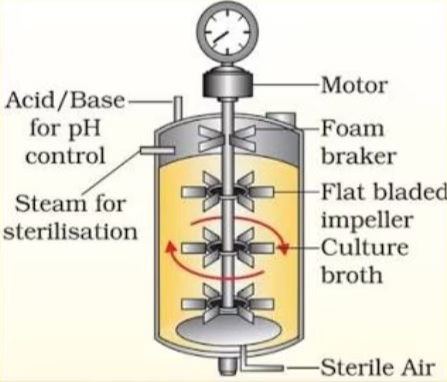
The most commonly used type is the stirred-tank bioreactor, which has a cylindrical vessel with a curved base for better mixing. A sparged version bubbles sterile air through the culture, which greatly increases the surface area for oxygen transfer.
Components of a bioreactor
| Component | Function |
| Agitator (stirrer) system | Mixes the contents evenly and makes oxygen available throughout |
| Oxygen delivery system (sparger) | Supplies sterile air as fine bubbles |
| Foam control system | Foam breaker prevents foam build-up |
| Temperature control system | Keeps the culture at the optimum temperature |
| pH control system | Acid or base is added to maintain pH |
| Sampling ports | Allow culture to be withdrawn periodically for testing |
Downstream processing (DSP)
The product formed in the bioreactor (an enzyme, alcohol, antibiotic or recombinant protein) is still crude. Downstream processing is the series of steps of separation and purification that makes it ready for the market:
- Separation of the product from the cells and culture medium
- Purification
- Formulation with suitable preservatives
- Clinical trials (in the case of drugs)
- Strict quality control testing for each product
Upstream processing is the part before this: preparing the recombinant organism and growing it in the bioreactor.
13. Revision Table and Exam Tips
Key terms at a glance
| Term | Meaning |
| Cloning | Making multiple identical copies of a DNA segment |
| Vector | DNA molecule that carries foreign DNA into a host |
| Recombinant DNA | DNA formed by joining DNA from two different sources |
| Palindrome | Sequence that reads the same in 5′→3′ direction on both strands |
| Sticky ends | Single-stranded overhangs left after staggered cutting |
| Insertional inactivation | Loss of gene function because foreign DNA is inserted in it |
| Competent cell | Cell able to take up foreign DNA |
| Elution | Extraction of DNA from the cut agarose gel piece |
| Primer | Short oligonucleotide that starts DNA synthesis |
| Bioreactor | Vessel for large-scale culture and product formation |
| DSP | Separation, purification and finishing of the product |
Diagrams to practise
- Action of EcoRI and formation of recombinant DNA
- pBR322 with labelled ori, ampR, tetR, rop and restriction sites
- Three steps of PCR
- Stirred-tank bioreactor (and sparged type)
Exam tips
- Always write why: palindromes give matching sticky ends; Taq is thermostable; the vector needs a single cloning site.
- Do not confuse restriction endonuclease (cuts inside) with exonuclease (cuts at ends).
- In blue-white screening, white = recombinant. In tetracycline selection, recombinants die on tetracycline.
- PCR has three steps (denaturation, annealing, extension). Many students forget annealing.
14. Practice Questions
Multiple-choice questions
- Which enzyme is used to break open fungal cells for DNA isolation?
(a) Lysozyme (b) Cellulase (c) Chitinase (d) Protease - The recognition sequence of EcoRI is:
(a) GGATCC (b) GAATTC (c) AAGCTT (d) CCCGGG - In pBR322, insertion of foreign DNA at the BamHI site results in loss of:
(a) ampicillin resistance (b) tetracycline resistance (c) ori (d) rop - DNA fragments in gel electrophoresis move towards:
(a) the cathode, because they are positively charged (b) the anode, because they are negatively charged (c) the cathode, because they are negatively charged (d) neither - The name Thermus aquaticus is associated with:
(a) Ligase (b) Taq polymerase (c) EcoRI (d) Reverse transcriptase - A recombinant colony in blue-white screening is:
(a) blue (b) white (c) red (d) green - The heat shock given to bacteria during transformation is usually at:
(a) 4 °C (b) 25 °C (c) 42 °C (d) 94 °C - Which of these is used to introduce DNA into plant cells by bombardment?
(a) Gold or tungsten particles (b) Ti plasmid (c) Calcium chloride (d) Retrovirus
Show answers
1-(c), 2-(b), 3-(b), 4-(b), 5-(b), 6-(b), 7-(c), 8-(a)
Assertion and reason
Q1. Assertion (A): PCR uses Taq polymerase. Reason (R): Taq polymerase remains active at the high temperature required for denaturing DNA.
(a) Both A and R are true and R explains A (b) Both true but R does not explain A (c) A true, R false (d) A false, R true
Q2. Assertion (A): A cloning vector should have only one recognition site for the restriction enzyme used. Reason (R): More than one site would cut the vector into several fragments.
(a) Both A and R are true and R explains A (b) Both true but R does not explain A (c) A true, R false (d) A false, R true
Show answers
Q1: (a). Q2: (a).
Short-answer questions
- Define cloning. Why does a piece of foreign DNA need a vector to be cloned?
- Explain the naming of the restriction enzyme EcoRI.
- What are sticky ends? How are they useful in rDNA technology?
- Why is ethidium bromide used in gel electrophoresis, and how is the DNA visualised?
- What is a competent host? Describe one method to make bacteria competent.
Long-answer questions
- Describe the three steps of PCR with a labelled diagram. Why is Taq polymerase preferred?
- Explain how insertional inactivation is used to select recombinants, with reference to tetR in pBR322 and to β-galactosidase.
- Describe a stirred-tank bioreactor and its components. What is downstream processing?
15. Frequently Asked Questions (FAQs)
Why are restriction enzyme recognition sequences palindromic?
A palindromic sequence reads the same in the 5′→3′ direction on both strands. This lets the enzyme cut both strands at matching positions and produce complementary sticky ends that can pair with any other fragment cut by the same enzyme.
Why is Taq polymerase used in PCR?
Taq polymerase is isolated from the thermophilic bacterium Thermus aquaticus. It is thermostable, so it is not destroyed by the high temperature used to denature DNA in every cycle.
How does insertional inactivation help in selecting recombinants?
When foreign DNA is inserted into a selectable marker gene such as tetR or the β-galactosidase gene, that gene stops working. Recombinants therefore lose tetracycline resistance or fail to produce blue colour, which distinguishes them from non-recombinants.
What is the role of calcium chloride and heat shock in transformation?
Divalent cations such as calcium make bacterial cells competent by increasing the efficiency of DNA entry through pores in the cell wall. A brief heat shock at 42 °C then helps the cell take up the recombinant DNA.
What is the difference between upstream and downstream processing?
Upstream processing covers preparing the recombinant organism and growing it in a bioreactor to make the product. Downstream processing covers the separation, purification, formulation and quality testing of that product before marketing.
Why is a continuous culture system preferred for large-scale production?
Used medium is drained out while fresh medium is added, so cells stay in the log phase. This produces a larger biomass and a higher yield of the desired protein.
Other topics you might be interested in:
Class 12 Biology Notes: Reproduction in Organisms
Sexual Reproduction in Flowering Plants: Class 12 Biology Notes
Human Reproduction Class 12 Notes Biology
Principles of Inheritance and Variation — Class 12 Biology Notes
Molecular Basis of Inheritance Class 12 Notes (DNA, RNA, Replication, Transcription & Translation)
Evolution Class 12 Biology Notes: Origin of Life, Darwin’s Theory
Human Health and Disease Class 12 Notes
Strategies for Enhancement in Food Production Class 12 Biology Notes