Null Hypothesis and Alternative Hypothesis – Definition, Examples & Differences
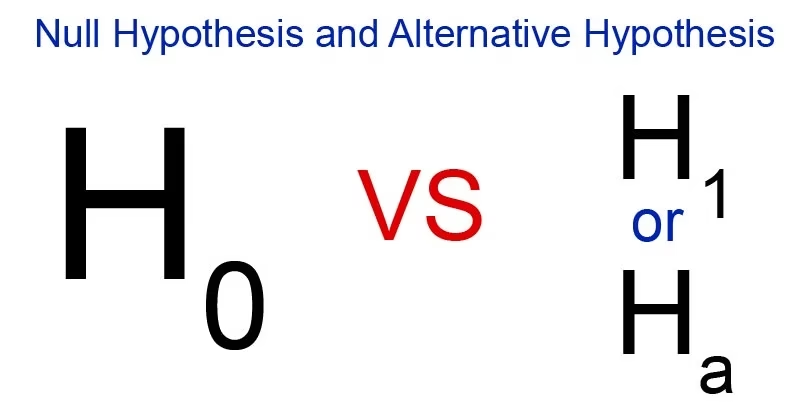
Learn the difference between null hypothesis and alternative hypothesis with definitions, symbols, examples, importance, and applications in biology research.
High-Performance Liquid Chromatography (HPLC) is one of the most powerful and widely used techniques in modern laboratories. It helps to separate, identify, and quantify different components of a mixture with high accuracy and efficiency.
A questionnaire is a structured set of questions designed to gather specific information from individuals or groups. It can be used in field surveys, experiments, population studies, and public opinion research. In biology-related research, questionnaires can be used to collect data on public awareness of conservation, health behaviors in communities, or local biodiversity knowledge.
Mass Spectrometry (MS) is a highly precise analytical technique used to identify and measure the amount of chemicals present in a sample. It works by ionizing molecules and separating them based on their mass-to-charge ratio (m/z).
When an object moves in a circular path, two important forces come into play — centripetal force and centrifugal force. Centripetal force is a real force that pulls an object towards the center of its circular path. Centrifugal force is a fictitious (pseudo) force that seems to push an object outward, away from the center.
The Bunsen burner is one of the most common and essential pieces of laboratory equipment. It produces a controlled, smokeless, non-luminous flame used for heating, sterilization, and combustion in various scientific experiments.
Pipettes are laboratory instrument used to measure and transfer small volumes of liquid with high accuracy. Pipettes are essential in biology, chemistry, medical research, food analysis, and biotechnology. They come in different types—glass, plastic, and electronic—and range in capacity from a few microliters (µL) to several milliliters (mL).
A centrifuge is an essential piece of laboratory equipment used to separate mixtures of liquids, or solids suspended in liquids, based on differences in density. It operates by spinning samples at high speeds, creating a centrifugal force that pushes denser particles outward and lighter particles inward.
Learn the differences between primary data and secondary data in biology with definitions, examples, advantages, disadvantages, and research tips.
Adsorption chromatography is a type of liquid-solid or gas-solid chromatography where compounds are separated based on how strongly they bind (adsorb) to a solid surface.